
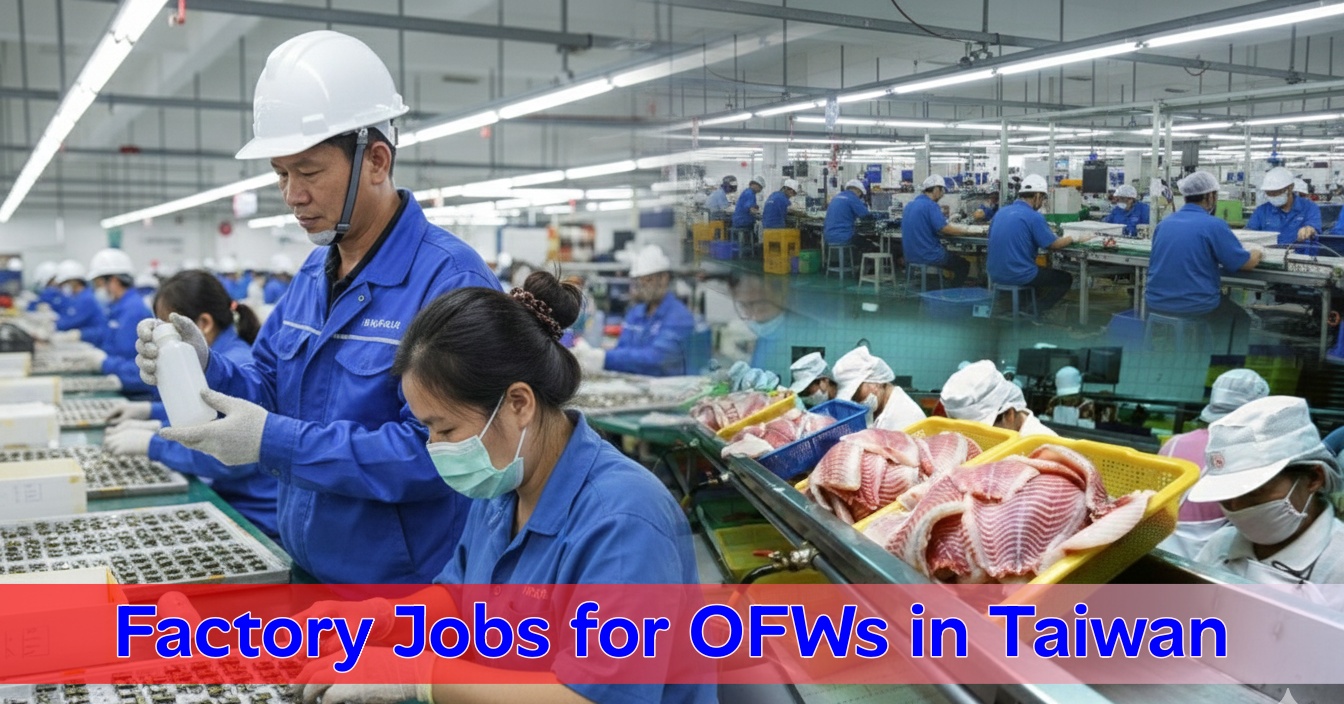
Working in a factory is one of the most common ways Filipinos start their OFW journey in Taiwan. Many arrive with no factory background and begin in entry-level roles. Over time, some move up into semi-skilled, technical, and even supervisory positions.
Entry-Level Factory Roles in Taiwan (Most Common for OFWs)
These are the jobs most Filipino workers start with. They require little to no prior experience and are usually arranged through licensed agencies.
Factory Worker / Production Line Worker
This is the most common factory job for OFWs in Taiwan.
What the job involves
- Operating basic machines or tools
- Assembling parts or components
- Packing finished products
- Inspecting items for visible defects
Industries where this role is common
- Electronics and semiconductors
- Plastics and rubber manufacturing
- Food processing and packaging
- Metal and light industrial factories
What to expect
- Shift work, including night shifts
- Frequent overtime, especially during peak seasons
- Standing for long hours
- Repetitive tasks that require focus and discipline
This role builds the foundation. Many OFWs start here to learn factory rules, safety standards, and work culture in Taiwan.
Machine Operator (Basic)
Some factories assign workers to basic machine operation after short training.
What the job involves
- Loading materials into machines
- Monitoring machine output
- Making simple adjustments under supervision
- Reporting machine issues
Where this role is common
- Electronics assembly
- Metal fabrication
- Plastic molding
This role is often the first step toward technical work. Workers who show care, accuracy, and reliability are often shortlisted for higher training.
Warehouse Operator
Warehouse roles support factory production and logistics.
What the job involves
- Handling inbound and outbound materials
- Packing, labeling, and sorting items
- Inventory checking and kitting
- Using pallet jacks or forklifts
Skills developed
- Inventory awareness
- Coordination with production teams
- Basic logistics knowledge
This role suits OFWs who prefer movement and coordination rather than machine work.
Semi-Skilled Factory Roles (Common Promotion Path)
After one to three years, some OFWs are promoted or transferred into semi-skilled roles. These positions require experience, trust, and basic technical understanding.
Quality Control (QC) Inspector
QC roles are critical in Taiwan’s manufacturing system.
What the job involves
- Inspecting finished products
- Using measuring tools like calipers and gauges
- Checking compliance with standards
- Recording defects and reports
Why this role matters
- Fewer mistakes mean fewer losses for the company
- QC inspectors are trusted with accuracy and judgment
Many OFWs move into QC after proving consistency on the production line.
Line Leader / Team Leader
This is often the first leadership role for OFWs in a factory.
What the job involves
- Supervising a small group of workers
- Coordinating daily tasks
- Reporting production issues
- Helping new workers adjust
Skills gained
- Leadership and communication
- Problem solving under pressure
- Coordination with supervisors
Line leaders are often considered for long-term retention or advanced roles.
Material Handler / Logistics Assistant
This role connects production and warehouse operations.
What the job involves
- Managing material flow inside the factory
- Ensuring the right materials reach the right stations
- Coordinating with warehouse and QC teams
This role builds a strong understanding of how the entire factory system works.
Skilled and Technical Factory Roles (Career Growth Targets)
These roles require training, certifications, or company sponsorship. They also come with higher pay and stronger job security.
CNC Operator / CNC Machinist
This is a recognized skilled role in Taiwan.
What the job involves
- Operating computer-controlled machines
- Reading blueprints and drawings
- Performing precision measurements
- Adjusting machine parameters
Why it is valued
- High accuracy work
- Fewer workers qualify for this role
- Skills are transferable across factories
Many OFWs aim for this role after years of experience.
Technician (Mechanical, Electrical, or Mechatronics)
Technicians are the backbone of factory operations.
What the job involves
- Troubleshooting machine problems
- Performing repairs and calibrations
- Supporting engineers during production issues
Common technician types
- Mechanical technician
- Electrical technician
- Mechatronics technician
This role often requires company-provided training or prior technical background.
Metrology Technician
This is a specialized role, especially in semiconductor factories.
What the job involves
- Handling precision measurement systems
- Supporting scanner setup and diagnostics
- Ensuring accuracy in high-tech production
This role is rare but highly respected and better paid.
Maintenance Technician
Maintenance technicians keep factories running.
What the job involves
- Repairing motors, sensors, and conveyors
- Performing preventive maintenance
- Responding to breakdowns
Factories value maintenance technicians because downtime costs money.
Supervisor / Shift Leader
This is the advanced leadership level.
What the job involves
- Managing entire production lines
- Overseeing manpower, quality, and output
- Coordinating with management and engineers
Most supervisors started as factory workers or line leaders.
Factory Career Growth Path for OFWs in Taiwan
Here is how these roles usually connect.
| Career Stage | Typical OFW Role | What You Gain |
| Starting | Factory Worker, Machine Operator | Discipline, factory basics |
| Semi-Skilled | QC Inspector, Line Leader | Technical exposure, leadership |
| Skilled | CNC Operator, Technician | Higher pay, specialization |
| Advanced | Supervisor | Full production leadership |
This progression is realistic and already experienced by many Filipino OFWs in Taiwan.
Why Factory Jobs Still Matter for OFWs
Factory work is demanding. But it offers:
- Legal employment
- Stable income
- Overtime opportunities
- Clear paths for skill growth
For many OFWs, factory work becomes a long-term livelihood, not just a temporary job.
How Likely Is Career Growth for OFWs in Taiwan Factories?
Career growth in Taiwan factory work is possible, but it is not automatic. Some OFWs move up within a few years. Others stay in the same role until their contract ends. The difference often comes down to a mix of timing, attitude, skills, and company policies.
The Short Answer
- Yes, progression happens for many OFWs
- No, not everyone moves up
- Growth is usually earned, not promised
Factories in Taiwan prefer workers who are stable, reliable, and willing to learn. When production is smooth, companies are more open to promoting from within.
What Improves Your Chances of Promotion?
- Length of Stay and Contract Renewals
OFWs who stay longer have better chances.
- First 1 to 2 years: learning phase
- After renewal: considered for QC or line leader roles
- Long-term workers: shortlisted for skilled or supervisory roles
Frequent contract renewals signal trust and stability to employers.
- Work Attitude and Reliability
This matters as much as skill.
Factories notice workers who:
- Arrive on time
- Follow safety rules
- Avoid frequent absences
- Finish tasks without constant supervision
Many promotions start with a simple thought from management:
“This worker can be trusted.”
- Willingness to Learn New Tasks
OFWs who volunteer to learn:
- New machines
- Different stations
- Simple troubleshooting
often get noticed faster.
Even small steps, like learning how a machine works instead of just operating it, make a difference.
- Basic Communication Skills
You do not need perfect Mandarin, but basic understanding helps.
Workers who can:
- Follow spoken instructions
- Read simple labels or screens
- Communicate problems clearly
are easier to assign to QC, logistics, or leadership roles.
Many line leaders and technicians started with very basic Mandarin, learned slowly on the job.
- Company Size and Industry
Not all factories offer the same growth chances.
Higher growth potential
- Semiconductor factories
- Electronics manufacturing
- Large export-oriented plants
Lower growth potential
- Very small factories
- Short-term project-based operations
Larger factories usually have:
- Clear role ladders
- Internal training programs
- Long-term retention plans
- Training and Certifications
Some factories offer:
- Internal technical training
- Safety and machine certifications
- On-the-job technician mentoring
OFWs who complete training are often first in line when skilled roles open up.
- Demand and Production Cycles
Promotion timing is not only about you.
Growth often depends on:
- Production expansion
- New machines or lines
- Retiring or leaving supervisors
Sometimes a capable worker waits simply because no position is open yet.
Common Reasons Why Some OFWs Do Not Progress
Understanding the limits helps manage expectations.
Some OFWs remain in entry-level roles because:
- They change employers frequently
- They prefer overtime over training
- They avoid leadership responsibility
- Their factory has limited role structure
Staying in the same role does not mean failure. For some, stable income matters more than promotion.
A Realistic Expectation for OFWs
- Entry to semi-skilled roles: fairly common
- Semi-skilled to skilled roles: possible but selective
- Skilled to supervisor: fewer openings, longer timeline
Progression usually takes years, not months.
Frequently Asked Questions (FAQ)
- Do I need experience to work in a Taiwan factory?
No. Most entry-level factory jobs accept first-time OFWs. - Can factory workers really become technicians?
Yes. Many technicians started as production workers and were trained by their companies.
Is overtime guaranteed?
Overtime depends on production demand, but many factories offer regular overtime.
Are skilled roles paid more?
Yes. CNC operators, technicians, and supervisors earn higher wages and often receive better benefits.
Final Thoughts
Factory work in Taiwan is not a dead end. For many Filipinos, it is a starting point.
Those who show discipline, curiosity, and patience often move into better roles over time. The path is not fast, but it is real.
If you are starting as a factory worker today, you are not stuck. You are building your foundation.
Opportunities may not appear immediately, but every shift brings new chances to learn and prove yourself.
Over time, dedication and a willingness to pick up new skills can open doors to advanced positions, higher pay, and greater responsibility.
Remember, many have started just where you are and, with steady effort, have been able to shape meaningful careers.
Stay focused, keep learning, and trust the process—your hard work can truly pay off.